Specialized Software for Language Translation and Localization
Specialized Software

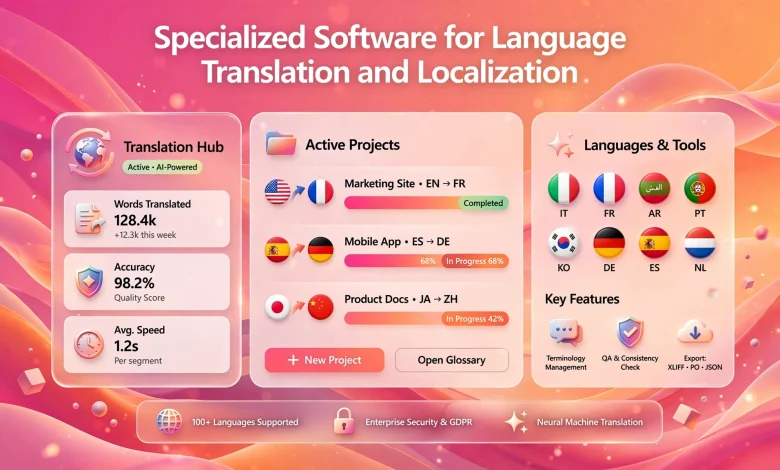
In the modern world, businesses, governments, education, and technology companies communicate with the audience constantly. Software that translates and localizes texts allow companies to establish more effective contacts. While translation is the presentation of the same text in different languages, localization is the customization of text and language. In this way, both methods can be used by businesses in a competitive environment.
What Is Translation Software Used For
Translation software uses mathematical algorithms to perform translation, coding, and decoding of various texts. It is implemented in different applications for easier communication through subtitles, website localization, technical documents or commercial correspondence. The use of computer-aided translation allows faster text processing without the need for constant and resource-consuming editing of word orders.
Differentiating Translating Software and Localization Software
While distinguishing translation and localization tools, the first category focuses mainly on the accuracy of translating terms in two different languages. At the same time, programs in the second category provide content alignment. Localized text is presented in a version familiar to the culture and social environment of the specific reading audience. This method is used, in particular, for applications, which are subject to localization.
Computer-Assisted Translation Tools
This category of translation tools is specialized in the work with language experts. The specific property of CAT-assisted programs is the ability to create translation memory or language warehouses. In this way, professionals who use these tools do not have to translate the same phrases over and over. Additionally, the programs offer linguistic quality control functions and various built-in dictionaries with lexical repetitions.
Machine Translation Tools and Artificial Intelligence
Artificial intelligence is actively used in modern programming solutions to ensure the accuracy and quality of the translation process. Thus, applications with AI capabilities can offer more effective and higher-quality results and are trained to recognize patterns better than rule-based translation tools. Nevertheless, it should be borne in mind that machine software does not recognize context errors. When using such programs, language nuances are always possible, which must be considered when correcting the text later.
Translation Memory Tools
Translation memories refer to a special category of linguistic warehouses. These programs’ purpose is using existing text solutions to maintain the company’s translation uniformity in the localizer’s work. At the same time, translation memories help reduce the overall cost of the process of textual customization. It is recommended to use these tools especially often by enterprises that need to localize and update website texts, dictionaries, documentation, specifications, or accompanying literature.
Terminology Management Tools
Terminology management tools are specialized software that focuses on the proper terminology of text presentation. First, this category is used in medical texts to maintain the same terms in different languages. Secondly, such programs are used when a particular area of professional users’ activity requires the representation of specific concepts. To preserve the uniformity of terms within the localized text, it is critical to ensure the consistent use of terminology when translating.
Website and Application Localization Tools
Website and application localization tools assist companies in ensuring the readiness of their software for the needs of their customers. Such programs are designed to handle linguistic subtleties, multilingual localization, text scaling, currency, time, and date notation. Thus, additional functions of these tools are identifying translatable parts of the application and hiding non-translatable parts of code to maintain the integrity of language elements.
Enhancing the Experience of the Customers Locally
The use of localization software helps companies ensure the widest acceptance of their services among the target audience. Better customer interaction can be achieved if users understand the language and presentation of not only the main body of the company but also its interface elements. Companies that invest in localization receive more consistent and favorable opportunities to provide the best value to their customers.
Quality Assurance Tools in the System of Localization
Quality assurance tools built into the localization software help ensure the quality of the production process. Various controls provide different levels of quality checks to ensure that texts are properly adjusted according to the customer’s instructions in terms of localization and translation. In addition, such programs have been designed primarily to find all the usual errors that recur during the implementation of the process of text localization. Therefore, quality assurance tools are recommended mainly for the control process with human participation at the end of the process.
Selecting the Localization Tools Criteria and Recommendations
When selecting the text translation tools to be used by a large company, several general criteria should be considered. In some cases, enterprises with a limited user base may be satisfied with the basic functions of the tools. At the same time, for large corporations with an extended network of partners, text localization and translation software have a broader set of tools: project managers and translators, translation memory, terminology management, linguistic quality,

and built-in tools for the integration of existing content management systems to help automate repetitive tasks.
Thanks