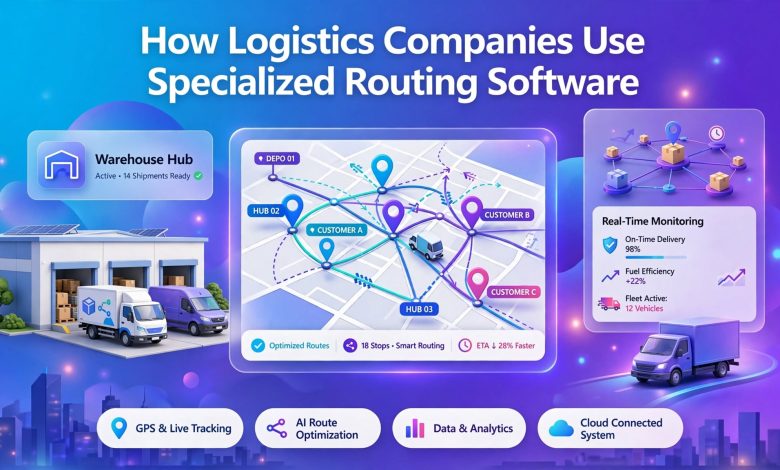
Many companies are engaged in logistics on a large scale. Their main goal is to deliver goods from a warehouse to retail stores, enterprises, and ordinary customers with minimal possible costs and in timely manner. However, optimizing delivery routes may be a challenging task if a company delivers goods to hundreds or even thousands of customers. Specialized routing software allows logistics companies to address this issue.
The software finds the optimal delivery route
It takes into account various factors such as the addresses of clients, the length of roads, traffic, vehicle capacity, and delivery dates and times. It allows logistics companies to establish the most cost-effective routes and minimize the distance driven.
Such software is useful because it helps reduce fuel costs
It is one of the largest expenditures in the logistics sector. In addition, software not only minimizes the distance driven but also reduces the time of the journey. As a result, the company needs fewer vehicles and fuel to provide delivery services.
Using this technology, logistics companies get an opportunity to organize multiple stops.
The problem of multiple stops is to find the order in which it is necessary to visit the points so that the greatest benefit is obtained. It is very difficult for a driver to solve this task without specialized software. Using this technology, logistics companies can save time and money by reducing the number of vehicles needed for delivery.
This solution helps to organize the delivery of goods to customers on time
Modern customers are demanding regarding the delivery of goods and services. Companies must not only deliver goods faster than before but also provide all clients with timely delivery. Routing software allows organizations to determine the duration of the journey and take into account all specific aspects of the delivery route.
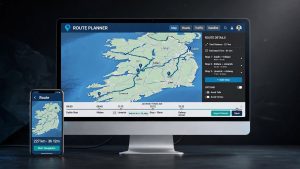
Some software can select routes that avoid traffic jams
They help drivers get to their destination in less time and make the delivery process more efficient.Another advantage of such software is the ability to consider the carrying capacity of vehicles.To ensure the safety and integrity of cargo, logistics companies must observe all norms and standards. Some vehicles are suitable only for transporting light goods, while others can carry heavy and oversized cargo. To maximize utilization of each vehicle, specialized software is needed.
Many solutions also have a GPS tracking system and fleet management tools
They allow the manager to monitor the location of vehicles in real-time and provide customers with detailed information about the location of their goods and the current status of the delivery route. Thus, companies can react much faster to any deviations and provide customers with timely delivery of their goods. Lastly, routing software helps to provide better customer service. On-time delivery and knowledge of the exact location of goods contribute to a better customer experience. Customers feel confident about their order as they know precisely when they will receive the goods.
Routing software also helps companies analyze the information received
For example, by studying the distance traveled, the time spent on the road, the software finds the most profitable routes. Information on fuel consumption, the driver’s driving style, and the state of the vehicle can also be helpful in finding the most cost-effective routes and reducing expenditures.
Conclusion
Finally, using this technology, logistics companies can scale their operations. As companies grow and the number of customers increases, the task of finding new routes may become more complicated. Specialized software allows logistic companies to simplify the task and save time on automating and accelerating the search process. Employees can focus on more meaningful tasks, such as analyzing and visualizing data. All the above qualities entice logistic companies to use such software.
The use of automated technologies contributes to the work of entire chains: from producers to customers.
Thanks