Best Practices in Software Troubleshooting for Startups
Software Troubleshooting

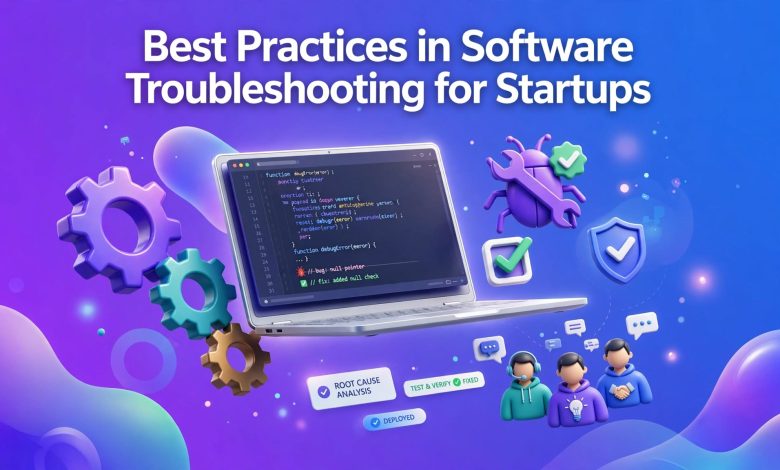
Modern startups rely heavily on the effective use of software to operate, communicate with clients, store and process data, and deliver products and services. At the same time, software-related problems may impede the functioning of a startup, lowering its performance and client satisfaction. For these reasons, an appropriate troubleshooting guide is particularly valuable for young companies that often operate on a limited budget and with reduced technical support. This guide seeks to provide a practical framework for startups to troubleshoot and prevent software-related issues.
Any attempt to troubleshoot should begin
any attempt to troubleshoot should begin with defining and describing the issue at hand. Ideally, before making any changes to the software, it is necessary to identify the problem or the sequence of actions preceding an error. Moreover, technical staff should document all actions taken to resolve an issue as well as the outcomes of these actions.
Troubleshooting always involves reproduction of the error
troubleshooting always involves reproduction of the error. This means that an issue should be detected in similar operating conditions as when it was first reported. Wherever possible, the technical staff should find a set of actions or inputs that can consistently produce the same error message. This will allow the developers to identify the underlying cause of the issue.
Ensuring that all applications and systems are updated
ensuring that all applications and systems are updated should be a primary measure in software troubleshooting. Often, errors are caused by applications that are no longer supported by developers. At the same time, updates to operating systems and other software may introduce new issues or inconsistencies, particularly if these updates are not compatible with certain applications. For these reasons, technical staff should operate with a dynamic list of recommended software versions that are known to function correctly together.
Documentation plays an equally important role in troubleshooting
documentation plays an equally important role in troubleshooting. In particular, technical staff should maintain an updated database of common errors along with the steps required to resolve these errors. With such a guide, troubleshooting procedures can be streamlined, and the need to involve specialized support in repetitive issues can be minimized.

Technical staff should use available tools to monitor the performance
technical staff should use available tools to monitor the performance of systems and spot issues before they become apparent to end-users. In practice, monitoring of system performance and logs should be performed on a regular basis to detect irregularities. By analyzing the operations of an application or a computer, developers can spot the cause of an error.
Necessary to properly prioritize software-related issues
it is necessary to properly prioritize software-related issues. Some problems may have a limited impact on the operation of a business and thus should be placed on a “low” priority, while others may require immediate attention. The division of issues into low, medium, and high priority is essential for young startups that may have limited technical support and resources.
implementing any proposed solution
before implementing any proposed solution, technical staff should conduct a series of tests to ensure that there are no secondary issues. Ideally, the proposed solutions should be tested in appropriate test environments and, where possible, with test users. The purpose of these tests is to minimize the possibility of introducing new errors and issues.
Technical staff should focus on the root cause of an issue
when troubleshooting, technical staff should focus on the root cause of an issue, not its symptoms. The resolution of software problems should always be targeted, addressing the reason for the malfunction rather than eliminating its effects. Determining the root cause of an error is particularly important in complex systems where problems are often interrelated. For example, incorrect system settings can cause malfunctions unrelated to the settings error itself.
Technical staff should always have a systematic approach
technical staff should always have a systematic approach for restoring systems and applications following an issue. A working knowledge of system restoration procedures is critical for reducing the losses associated with software-related problems. In particular, technical staff should always have up-to-date system backups that can be used to re-install applications or restore individual data sets.
Conclusion
Software troubleshooting is an integral part of operations of modern startups. Technical staff should implement a combination of troubleshooting measures aiming to prevent software-related problems, detect these problems when they arise, and resolve these problems with minimum delay. As a result, technical staff can focus on more pressing issues, and the overall performance of the company can be improved, benefiting the clients. These ends can be achieved through thorough analysis of each error, reproduction of the error, and testing of potential solutions prior to implementation.

Backups and systematic system recovery procedures should also be established and regularly updated.
Thanks