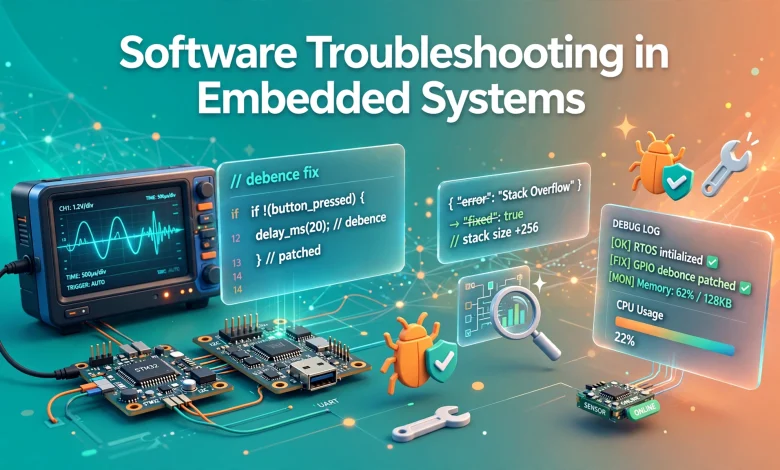
Some companies make embedded systems for cars, medical devices, home appliances, industrial machinery, or consumer electronics. These systems require different types of software to control hardware components and manage specific tasks. If embedded software malfunctions, it may be hard to troubleshoot the error due to its nature. It is vital to go through a standard troubleshooting process and understand what issues can occur in embedded software in order to deal with them.
Troubleshooting Common Software Issues in Embedded Systems
Compared to regular computer software, embedded applications have to run on a specific hardware platform with a set of constraints. Because of the close connection between software and hardware, even a small line of erroneous code can corrupt the whole system.
Therefore, embedded software tends to experience system failures and bugs such as unexpected reboots and sensor inaccuracies. Troubleshooting these issues requires analyzing their symptoms and causes. In general, the main purpose of the embedded systems troubleshooting is to define the irregularity and go through the process of eliminating it.
Check the Error’s Symptoms
Prior to making any changes, it is critical to observe the situation and collect the necessary evidence for the further investigation. The more details and precise descriptions of the irregular behavior the development team can get, the faster it will resolve the issue.
Specifically, the engineers should look for answers to the questions when the error starts, if it is a one-time occurrence or a persistent, and whether there are certain environmental conditions or actions that lead to its occurrence. All observations and findings should be noted and checked.
Debug the Code
The next step is to debug the code which probably has errors causing the system malfunction. Developers should use special debuggers to go through the code line by line and see what instructions the processor executes. Debuggers allow setting break points that help the developers understand what code causes irregularities and what assumptions it makes.
In addition, it may be helpful to add logging statements that will print out the information about the program’s execution process. However, it is vital to ensure that the extra code does not impact the target system’s behavior.
Check Memory-Related Issues
Software in embedded systems can experience memory issues such as buffer overflow, memory leak, wild pointers, and stack overflow. These problems may occur due to improper memory management and allocation. To troubleshoot these issues, the developers should check the code for errors and use special static analysis tools that detect memory problems.
Many embedded systems have hardware limitations and do not have enough memory and processing power. It makes memory-related errors quite common in such systems.
Make Sure All Time Constraints Are Met
In real-time systems, a program has to meet all time constraints. If it fails to do so, it will not function properly. To ensure that the code does not miss deadlines, the developers should evaluate the tasks’ scheduling and see if they are performed in the right order.
It is also essential to check interrupts, timers, and delays for irregularities such as unnecessary waiting periods or processing time. By calculating the processing time, the developers will see if it correlates with the missed deadlines.
Evaluate Hardware Components and Interconnection
The software and hardware in embedded systems are highly integrated, and software issues are often the result of hardware problems. For example, the chip may not be properly connected to the board or the sensor may send incorrect data due to static electricity.
To troubleshoot such issues, the developers should evaluate the hardware interface, make sure that all components are compatible and correctly installed, and check their functionality. This step should also involve reviewing the logic of the data exchange and communication protocols, voltage levels, pins, addresses, and other details.

Check Communication Issues
Modern embedded systems are quite complex and often contain multiple devices interconnected with each other. Software communication issues are often the result of the incorrect baud rate, address, data format, or a faulty cable or improper signal levels. Developers should use logic analyzers and oscilloscopes to identify communication irregularities and find the source of the problem.
Use Test Cases to Find the Issue
The developers should create unit tests for separate components and system tests for the whole application to identify the malfunction. This testing strategy will help locate the error and see how the system works after the changes. In general, all test cases should be run every time the code is updated.
Document the Issue and the Solution
Once the issue is resolved, it is critical to document this experience and describe the malfunction along with the solution. It will help the developers troubleshoot similar issues and avoid them in the future. In addition, the code should be updated only after sufficient testing, and the test cases should not fail.
Prevent Future Issues
Experienced developers know that troubleshooting and solving issues in the embedded systems software is not enough. They aim to prevent errors by choosing the right development practices such as code reviews, system tests, and static analysis to ensure that no issues are present. The continuous testing of the code helps the developers monitor the system’s health.
Conclusion
Overall, troubleshooting embedded systems requires time, effort, and patience. The development team should not jump to conclusions and systematize the troubleshooting process. Instead of assuming that a certain error is caused by a specific issue, the developers should take a step-by-step approach, go from general to specific, start with the simplest solutions, and proceed to complex ones. The effective troubleshooting and prevention strategies help the embedded systems developers create bug-free, high-performing, and efficient applications. As the use of embedded systems continues to grow,

these strategies play a crucial role in the development of reliable Internet of Things products and smart devices.
Thanks